
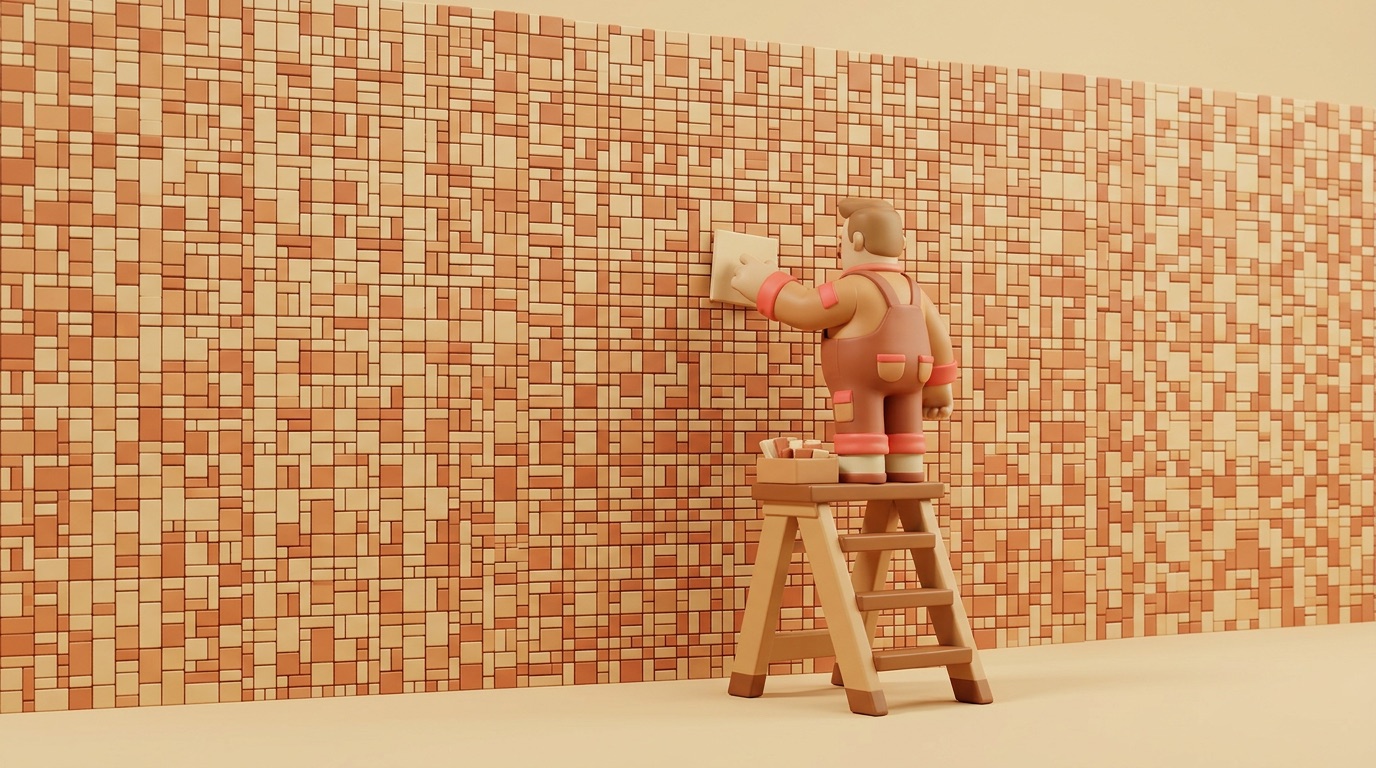
From a million pixels to an Instagram bid
Twenty minutes after outbid.lol went live, Michał Ordon replied:
Haha! I love this!
I literally did the same thing during the Million Dollar Homepage craze 20 years ago and got it to a whole $2!
Let me boost it up a bit!
— @designorant, Aug 19, 2026
That reply is the genealogy. Before Polar webhooks, before .lol domains, before a $14,000 bid on an AI computer company, there was a 1000×1000 grid and a 21-year-old in Wiltshire trying not to graduate with a hole in his bank account.
instabid sits on that line. Not because we sold pixels, and not because we take the same money Jonathan is taking. Because the joke keeps coming back: put a public price on a public place, and people will fight over it in a way they will not fight over a follower count.
2005: one dollar per pixel
The Million Dollar Homepage launched on 26 August 2005. Alex Tew, 21, from Cricklade, about to start a business degree at Nottingham, was scared of the student loan. Setup cost was about €50 for a domain and hosting. The home page was a million pixels. He sold them at $1 each, in 10×10 blocks, so the smallest purchase was $100. Buyers sent a tiny image, a URL, a hover slogan.
He priced in dollars on purpose. The US had more people online, and the pound was strong — about $1.80 — so a pound-priced pixel would have felt expensive. The first sale was a friend’s music site, 400 pixels, three days in. Friends and family got him to 4,700 pixels in two weeks. Then a press release hit the BBC, The Register wrote it up, and the thing became an internet event instead of a dorm trick.
By the end of September he had $250,000 and a high Alexa “movers” rank, sitting near Britney Spears. On 26 October, two months in: 500,900 pixels sold to 1,400 customers. By New Year’s Eve, 999,000 pixels were gone and the site was getting 25,000 unique visitors an hour. The last 1,000 pixels went to eBay rather than a second homepage. The auction drew 99 legitimate bids, a pile of fake ones Tew had to kill by phone, and a winning $38,100 from a diet store. Gross total: $1,037,100. After costs, tax, and a donation to The Prince’s Trust, he figured he would net something like $650k–$700k. He dropped out of the degree the site was supposed to fund.
Then came the other half of the folklore. A group calling itself “The Dark Group” emailed a $5,000 ransom, then $50,000, then DDoS’d the site during the auction. It was down a week. Wiltshire police and the FBI treated it as extortion, probably out of Russia. The Wall Street Journal wrote that the page inspired a wave of pixel-selling copies. Many of those copies were worse. Many of the original links later rotted. As of 2019 the page still had thousands of daily viewers, a fossil that kept getting traffic because the story was better than the ads.
If you have never opened it, the surviving grid is worth a look. It is ugly in a way no modern startup would ship. That ugliness is the honesty. You can see every buyer at once. Nobody is hiding in an algorithm.
What Tew actually invented
Not pixels. Pixels were the unit. The invention was a finite, visible inventory of status, sold in public, cheap enough to start, expensive enough at the top to make a headline.
The finiteness mattered. A million pixels is a number you can feel. Instagram follower counts are not finite in a way you can play. There is always another follow. There is never a last pixel.
The visibility mattered. A 10×10 block with a loud GIF is a screenshot. A private media buy is not. Tew’s press release worked because the homepage was the press release.
The copycats mattered too, as proof. Pixel pages spawned for every country, every niche, every “million euro homepage.” Most of them made nothing, because they had the grid without the moment. That sentence will keep being true in 2026.
2026: rank is the bid
Jonathan Wilke’s version throws away the grid and keeps the public price.
You do not buy a rectangle. You buy a sort order. There is only one #1. The next person can take it by paying more. The inventory is not a million pixels. The inventory is the embarrassment of being #2.
He launched at 11:08pm on 19 August 2026 with the line that is already folklore:
No ads. No API keys. No revenue sharing.
Just outbid your competitors to rank #1 and consider marketing done for today
The 24-hour recap was 200k visitors and $21,499. The 36-hour recap was $42k, a $10k bid, a million visitors, ten copycats. The about page, when we scraped it, showed $125,080 revenue and a $14,013 high bid from joni.ai, plus a visitor counter that had gone through one analytics provider already. Someone offered $100k to buy the site before the first full day was over.
Michał’s $2 in 2005 and Lewis Carhart’s $10k in 2026 are the same gesture at different scales. Both are people putting a number on a public square because the square is being watched. The watched-ness is the product. Tew needed the BBC. Jonathan needed X. The medium changed. The square did not.
There is also a direct craft line. Tew sold static ads that stayed put. Jonathan sold a live auction that generates a new screenshot every time the crown moves. That is why the clones arrived in hours instead of months. You cannot screenshot a pixel grid into virality every hour. You can screenshot a new #1.
The thing that did not change: copies, ransom, arguments about whether it is a scam
Jesse Hanley called outbid a “Scammy campaign” in the first twenty minutes. Tew’s site got DDoS ransoms. Jonathan’s site got bot-click accusations and a scramble to switch analytics. Different decades, same shape: the second a public price attracts a crowd, someone tries to tax the crowd, game the crowd, or denounce the crowd.
We are not going to referee “is outbid a scam.” Companies with cards out, including Comp AI talking about 30% demo win rates after taking the throne, treated it as a channel. Other people treated it as a carnival game. Both can be true at once. The Million Dollar Homepage sold space to casinos, diet shops, Yahoo!, Tenacious D, and get-rich-quick pages. Respectable and trash sat in adjacent 10×10 blocks. That is what a public square looks like.
instabid will have the same mix, except the rows are Instagram profiles. Some will be friends messing around. Some will be brands. Some will be handles added by someone else as a dare. Public profiles are public. We hide on request.
Why Instagram is the right 2026 grid
A pixel is a location. A URL on outbid is a location. An Instagram handle is a person-shaped location.
That last one is the reason this site is not another .lol auction for SaaS. The 2026 clone wave already covered products, apps, categories, even a Flappy Bird king-of-the-hill. The unused grid was the app where status already lives.
Look at the current monuments, from Wikipedia and Instrack, mid-2026:
| Handle | Who | Followers (approx.) |
|---|---|---|
| the app itself | 685–686 million | |
| @cristiano | Cristiano Ronaldo | 678–680 million |
| @leomessi | Leo Messi | 516 million |
| @selenagomez | Selena Gomez | 404 million |
| @therock | Dwayne Johnson | 382 million |
| @kyliejenner | Kylie Jenner | 381 million |
| @nike | Nike | 291 million |
Those are Tew’s sold-out pixels. They are not getting un-sold. You cannot buy 10,000 of Cristiano’s followers in a 10×10 block and put your GIF there. You can, on instabid, put a $5 chip on a handle and sit above a monument if the monument does not chip back.
That is a dumber grid than a million pixels, and a ruder one. We think rude is the point. Instagram spent fifteen years pretending a follower count was a ranking. It is a fossil. A bid is a live pixel.
What we kept from Tew, what we kept from Jonathan, what we threw out
From Tew:
- One page you can understand without a tour.
- A public inventory of status.
- The knowledge that copies will show up, and that most of them will miss the moment.
From Jonathan:
- Rank as a single number that anyone can beat today.
- The launch sentence, credited, not reused as if it were ours.
- The lesson that the screenshot loop is the distribution.
Thrown out:
- Actual dollars. Tew needed tuition. Jonathan has Polar and a merchant-of-record problem worth solving because the bids are real. Our $5 is a chip. Re-add the handle, it becomes $10. No webhook. No invoice. If you want to fund somebody’s rent, fund Jonathan. He earned that week.
- The idea that this is “marketing done for today.” For outbid’s buyers, sometimes it was — Comp AI’s sales team said so in public. For Instagram handles, it is a flex. We will not sell it as a performance channel.
The $2 that still matters
Michał’s $2 is the most important number in this history after the $1,037,100, and maybe after Jonathan’s $21,499 day.
Most people who show up to a public square like this will not be Yahoo! and will not be joni.ai. They will be the $2. They will be the friend who bought 400 pixels. They will be Charlie J posting “Decided to get in on the fun, I’m sure I’ll be outbid (lol) soon.” They will be the 400-follower account on instabid.
If you design only for the $14,013 bid, you build a casino for whoever is already loud on X. If you design for the $2, you build a board a normal handle can enter without a finance meeting. Our increment is $5 because it should feel like the $2, not like the $10k.
Tew’s minimum was $100 because 10×10 pixels at $1 required it. Jonathan’s board, on the homepage we scraped, still advertised new spots at $5 even while #1 was five figures. The floor is the product for everyone who is not having a bidding war. The ceiling is the screenshot. You need both or you just have a rich-person leaderboard, which Instagram already is.
Fossils and live animals
The Million Dollar Homepage is still online. A lot of the links are dead. That is what happens when you sell a screenshot that outlives the companies in it.
outbid will have a version of that problem if the viral week ends and the high bids stay as monuments to a weekend. Jonathan can keep it alive as a real channel, or it can freeze into folklore with a big number on the about page. Either outcome still counts. Tew’s page is folklore and still, in a way, works.
instabid is too new to be a fossil. The job, for now, is to stay a live animal: real avatars, real follower counts, a bid that still moves when someone cares. We fetch a profile once, we keep it, we refresh on a six-hour cycle if it gets touched, we re-host the pictures. That is the unromantic work that makes a grid not rot on day three.
The line we are actually on
2005: sell the page.
2026, outbid: sell the rank, take the money, let startups duel.
2026, instabid: keep the rank, point it at Instagram, do not take the money.
We are not the sequel that makes $1,037,100. We are the side-quest that noticed Instagram was already a grid, and that the follower numbers on it had been fake rankings for years.
If you want the original pixel page, it is still at milliondollarhomepage.com. If you want the original 2026 auction, it is outbid.lol, still Jonathan’s, still linked from our footer. If you want to put a handle on a board that sorts like spite instead of fame, that is this site.
Michał got to $2 last time. He said he would boost it a bit this time. That is the correct spirit. Bring the $2 energy. Leave the monuments to people who already have 291 million friends they have never met.